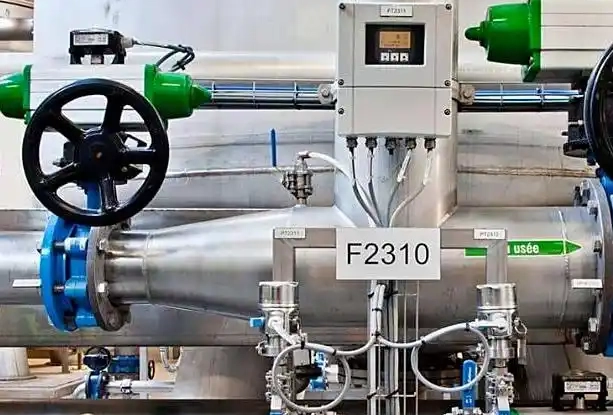
Level measurement is a huge part of instrumentation science and technology research, and it’s super important in loads of industrial areas like petrochemicals, water treatment and pharmaceuticals. They’re super accurate, really stable, and can handle a wide range of environments, making them the go-to choice for modern industrial automation and control systems.
What is a magnetostrictive level transmitter?
A magnetostrictive level transmitter is a high-precision instrument that uses the magnetostrictive effect to measure levels. Electrical pulses emitted within the sensor probe interact with the magnetic field generated by a magnetic float that moves in accordance with the liquid level.
This interaction creates mechanical torsional waves, and by measuring the propagation time of these waves, the device accurately calculates the liquid level. It can simultaneously measure liquid level, interface position and multi-point temperature, and is characterised by high measurement accuracy, stable performance and broad applicability across various operating conditions. It is commonly used for liquid level monitoring in various storage tanks and reaction vessels.
What is the working principle of a magnetic level transmitter?
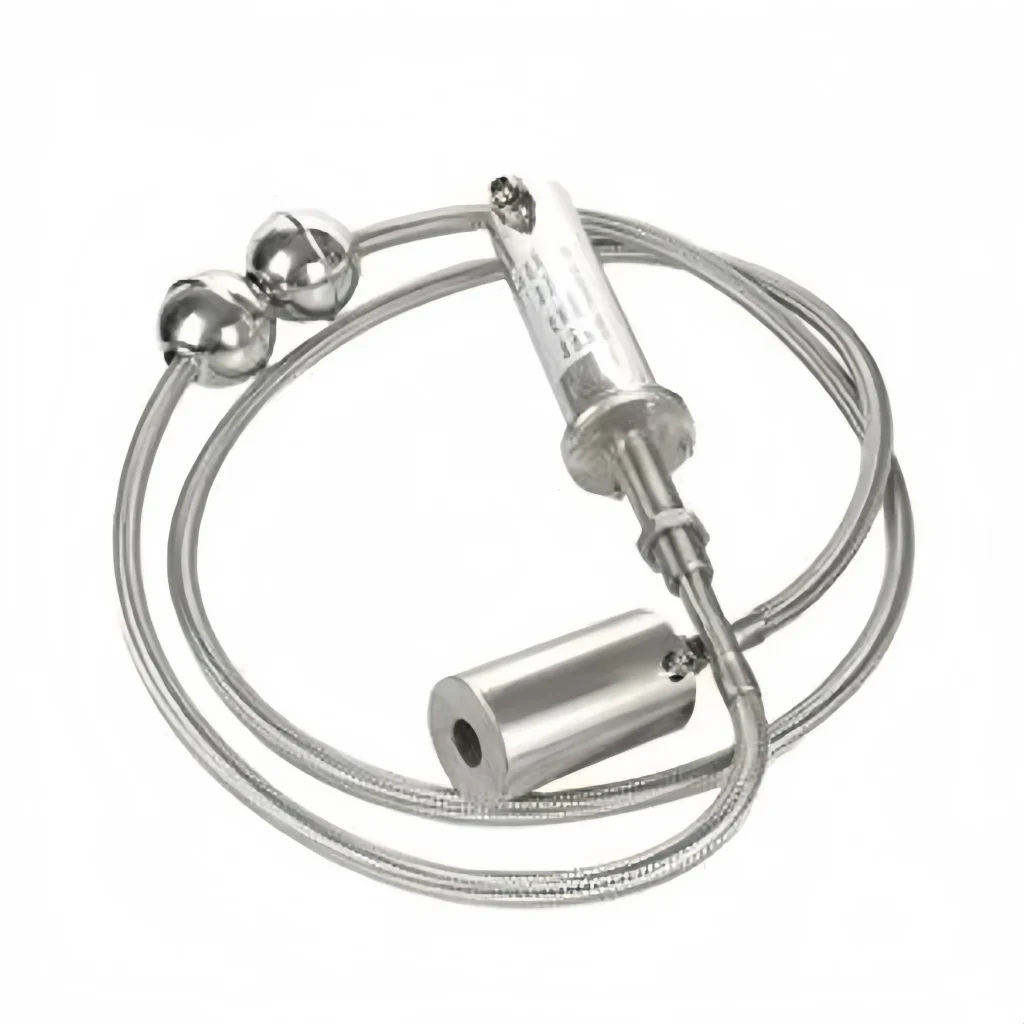
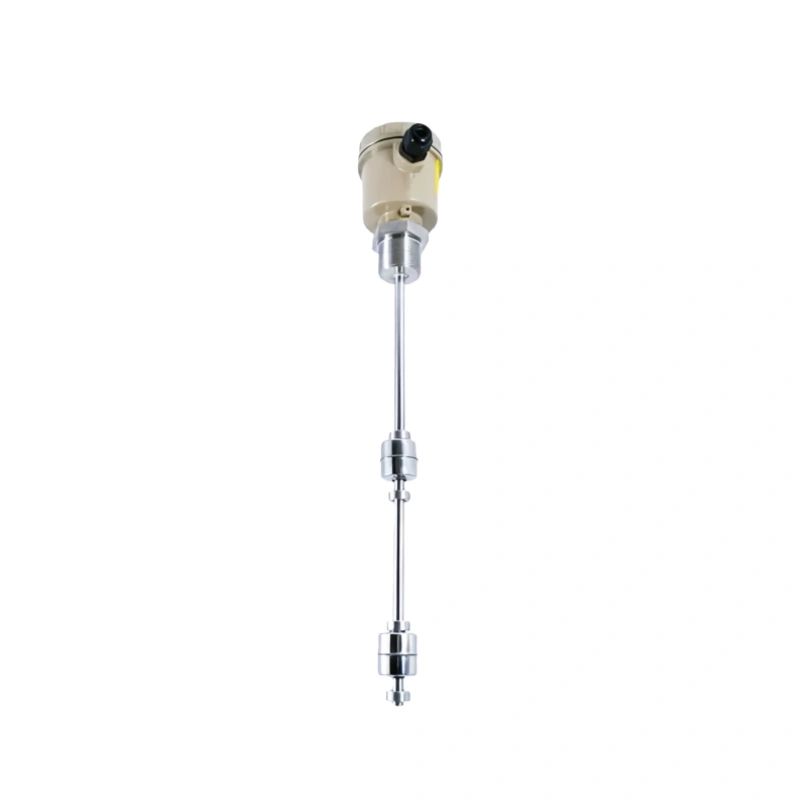
The core of the magnetostrictive level transmitter lies in the magnetostrictive effect. The device primarily consists of three parts: an electronic transmitter, a float (with a built-in permanent magnet ring) and a probe rod.
The probe rod is made of a special magnetostrictive material capable of producing minute expansions and contractions in response to changes in the external magnetic field.
1. Pulse excitation: The electronic transmitter sends a short current pulse to the sensing rod at regular intervals. This pulse creates a magnetic field within the rod, which travels quickly along its length.
2. Magnetic Field Interaction: The float rises and falls with the water level, and is made of a material that creates a static magnetic field. When the magnetic field from the transmitter meets the static magnetic field of the float, a magnetostrictive effect is triggered where the two fields meet. This causes a small wave pulse to be generated at that point by the sensing rod.
3. Signal Detection and Processing:The torsional wave pulse moves along the probe rod at a fixed ultrasonic speed in the opposite direction to the electronic transmitter, where it’s picked up by the detection mechanism and turned into an electrical signal.
By measuring the time difference between transmitting the initial pulse and receiving the torsional wave signal with precision, and combining this with the known propagation velocity of the torsional wave, it is possible to calculate the actual distance of the float relative to the base of the sensor. This determines the height of the liquid level.
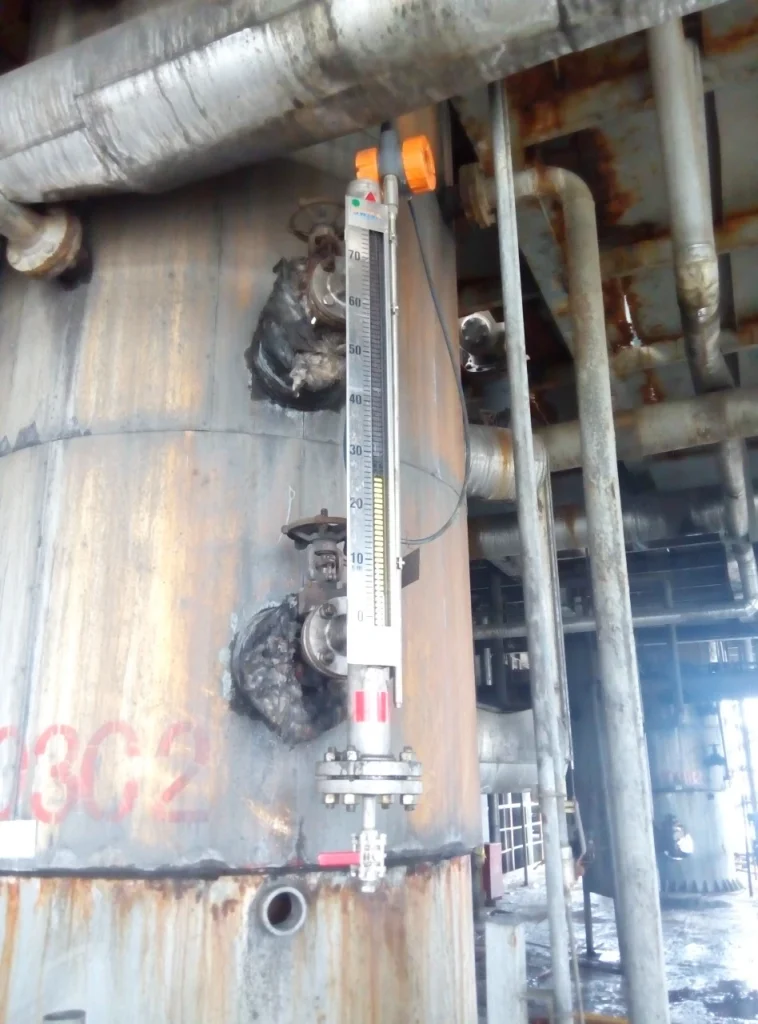
When is a Magnetostrictive Level Transmitter the Right Choice?
Applications Suitable for Magnetostrictive Level Transmitters
1. We’re talking about measuring clean liquids here, like petrol, diesel, various organic solvents, mildly corrosive chemicals, as well as industrial water and pure water. These media contain no significant impurities, are not prone to adhesion, and have no viscous deposits.
They will not cause the level gauge’s magnetic float to stick or jam, nor will they block the internal structure of the probe or cause corrosion-related interference. This ensures long-term, stable measurement performance, guaranteeing the continuity and accuracy of level data, and meeting the level monitoring requirements of most conventional equipment such as storage tanks and reactors containing clean media.
2. Applications involving clean liquids, including petrol, diesel, various organic solvents, mildly corrosive chemicals, industrial water and purified water. These media contain no significant impurities and are not prone to adhesion; they will not cause jamming, blockages or corrosion of the magnetic float or probe, ensuring long-term stable measurement and accurate data. They are suitable for level monitoring requirements in conventional clean media storage tanks and reactors.
3. Applications with extremely high accuracy requirements, particularly those requiring ±1 mm precision, such as custody transfer, high-precision tank metering and scientific research experiments. Thanks to their high-precision characteristics, magnetostrictive level transmitters can meet these stringent demands. With a resolution of 0.1 mm, they prevent losses and risks caused by measurement errors, outperforming conventional level transmitters.
4. In places where there might be foam or vapour, such as chemical reactors, food fermentation tanks and boiler drums, magnetostrictive level transmitters are unaffected by foam thickness or vapour concentration because of their special way of measuring. They can get past the interference layer to accurately measure the liquid level, which makes them more adaptable and stable than ultrasonic or float-type level transmitters. This helps to prevent measurement distortion.
5. When you need to measure both liquid level and the interface at the same time, for example in oil-water separation tanks in the petrochemical industry or acid-alkali stratified tanks, magnetostrictive level transmitters can help. These are specially designed to monitor both the liquid level and the medium interface at the same time. This eliminates the need for additional equipment, simplifying processes and reducing costs, whilst ensuring accurate synchronised data to meet multi-parameter measurement requirements.
Applications where magnetostrictive level transmitters are notrecommended
1. When dealing with high-viscosity, crystallising or scale-forming media. This can stop the magnetic float of the magnetostrictive level transmitter from working properly, which can affect how accurate the measurements are. In these cases, it’s usually best to go for guided wave radar (GWR) or radar level transmitters.
2. Applications involving extra-large storage tanks (over 15 m in height). Due to limitations on the probe length of magnetostrictive level transmitters, they cannot meet the measurement requirements of extra-large storage tanks. It is recommended to select servo gauges or radar level transmitters.
3. When you’re measuring a solid or powder, the way magnetostrictive level gauges work is by using a magnetic float to rise and fall, which makes them not very good for measuring the level of solids or powders. In these cases, it’s usually best to go for a radar or ultrasonic level gauge.
4. In places where there’s a lot of electromagnetic interference, it might mess with the electrical pulses and signal transmission of magnetostrictive level gauges, which can lead to messed up and unstable measurement data. We don’t recommend using them in these conditions.
Selection Procedure
Selection based on measurement range
Determine the actual measurement range: taking into account process parameters, site surveys or historical data, clearly define the liquid level range. Match the range to requirements for small vessels (0.5–5 metres) and large storage tanks (10–30 metres) to avoid wastage or failure due to range deviation.
Allow for measurement range margin: Typically, the upper limit should exceed the actual maximum liquid level by 10%–20%, and the lower limit should be 5%–10% lower. In conditions with severe fluctuations, increase the upper limit margin to 20%–30% to ensure stable operation of the equipment.
Matching accuracy and measurement range: If you have a wider range, it will be harder to keep things accurate. If you need to be very precise (within 0.1% of the correct value), choose a high-precision model. For most monitoring tasks (within 0.5% of the correct value), standard-precision models are fine, but make sure you regularly check them to keep them accurate.
Selection based on medium characteristics
Corrosive media: If it’s a highly corrosive environment, go for materials like titanium alloys or Hastelloy, with probes made from materials that don’t rust, like PTFE. For mildly corrosive media, use 316L stainless steel with a well-sealed structure that can be easily maintained in the future.
Viscous media: Pick a measuring rod with a sleek, polished surface and an anti-adhesive float. If you’re dealing with really viscous stuff (≥1000 cP), go for models with enhanced drive mechanisms or automatic scraping functions to stop the float from getting stuck.
Volatile/flammable and explosive media: Select models with excellent sealing performance that comply with explosion-proof standards (Ex d/ia/e, etc.). Gas detection and interlocking control functions can be fitted as required to suit hazardous environments.
Other factors to consider
Installation and Environment: Select top-mounted (for large vertical tanks) or side-mounted (for horizontal tanks) configurations as required, and verify connection dimensions; for high-temperature, low-temperature, high-humidity or strong electromagnetic environments, select suitable materials and protection ratings (≥IP65).
Signal and Communication: Standard models use 4–20 mA analogue signals; for networking, select RS485; if integration into an automation system is required, choose models supporting protocols such as Modbus, ensuring compatibility with on-site power supply conditions.
Power Supply and Display: Prioritise 24 VDC power supply; where no external power source is available, select models with a battery life of ≥1 year; if on-site monitoring is required, choose models with an LCD/LED display; if not, select models without a display to reduce costs.
Accuracy and Cost: For high-precision applications, go for models with an accuracy of ≤±0.1% FS; for routine monitoring, models with an accuracy of ±0.2%–±0.5% FS are good; and for cost-effectiveness, choose based on your budget.
Magnetostrictive vs Other Level Technologies
Magnetostrictive vs Float Level Gauges
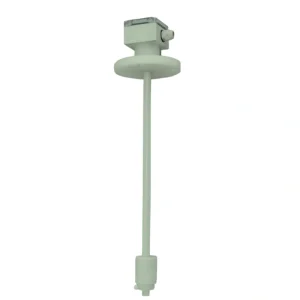
Both are contact-type level gauges, with the key differences lying in accuracy, functionality and cost. Magnetostrictive gauges offer extremely high accuracy, whilst float gauges have lower accuracy; in terms of principle, magnetostrictive gauges rely on magnetic fields and torsional waves, whereas float gauges utilise buoyancy and mechanical/magnetic coupling.
Magnetostrictive sensors support dual-float interface measurement, whereas float-type sensors do not; in terms of media, magnetostrictive sensors are suitable for high-temperature, high-pressure and clean liquids, whilst float-type sensors are only suitable for low-viscosity media such as clean water and ordinary oils.
Regarding maintenance, magnetostrictive sensors are wear-free and require minimal maintenance, whereas float-type sensors require regular checks for sticking or adhesion; in terms of cost, magnetostrictive sensors are relatively expensive, whilst float-type sensors are extremely low-cost, making them the economical choice.
Magnetostrictive vs Radar Level Transmitters
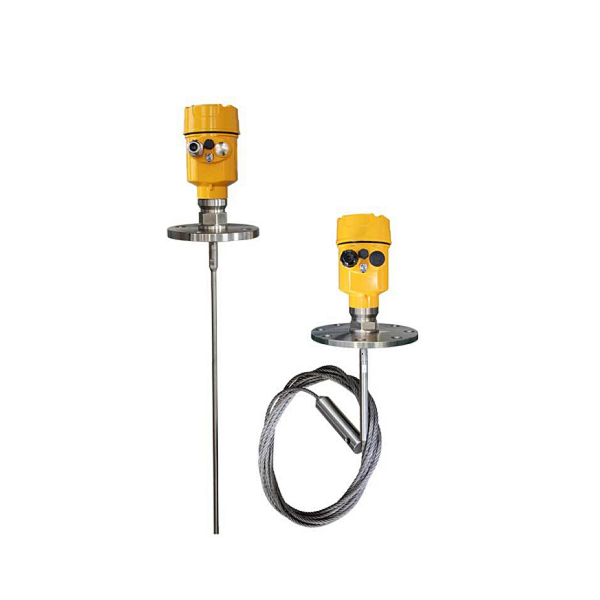
Both are high-end level measurement devices, with the core differences lying in their measurement methods and adaptability to operating conditions. Magnetostrictive transmitters are contact-type, whilst radar transmitters are non-contact; in terms of accuracy, magnetostrictive transmitters offer superior performance.
Radar transmitters are suitable for a wider range of media and can handle extreme conditions such as high temperatures and high pressures, whereas magnetostrictive transmitters are only suitable for clean, low-viscosity liquids. In terms of installation, magnetostrictive sensors require vertical top-mounted installation and have high precision requirements, whilst radar sensors offer flexible installation with no directional restrictions.
Both are relatively expensive, with magnetostrictive sensors falling into the mid-to-high price range and radar sensors being even more costly; magnetostrictive sensors are suitable for high-precision measurement and interface detection, whilst radar sensors are better suited to large storage tanks, extreme operating conditions and applications requiring non-contact measurement.
Magnetostrictive vs Ultrasonic Level Transmitters
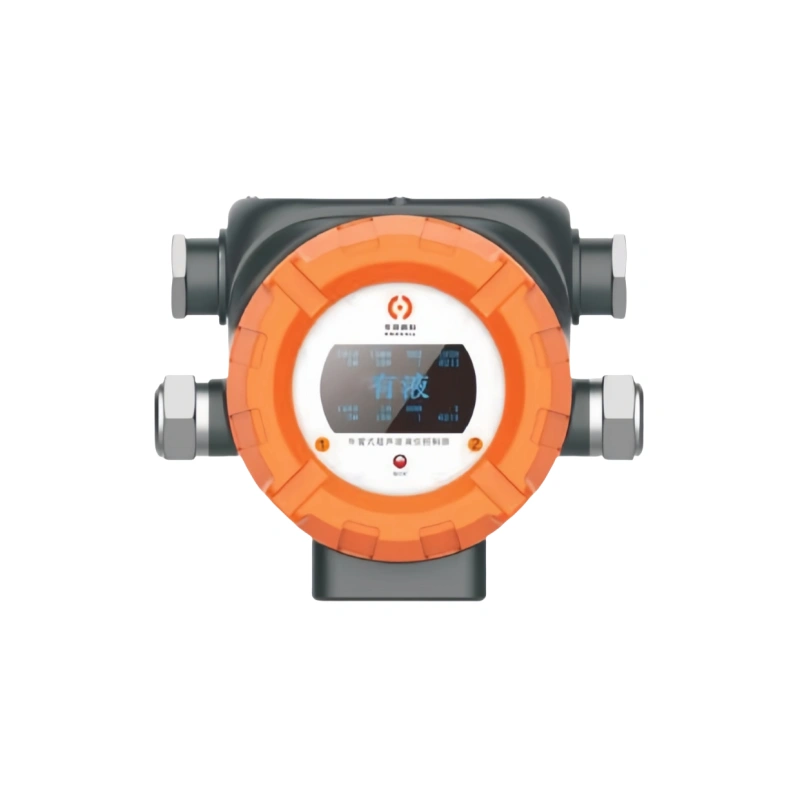
There is a significant difference in accuracy between the two: magnetostrictive transmitters have an error range of ±0.1–1 mm, whilst ultrasonic transmitters have an error range of ±0.5%–1% FS (±5–10 mm).
In terms of interference resistance, magnetostrictive transmitters are resistant to steam, foam and dust, whereas ultrasonic transmitters are significantly affected by these factors and exhibit poor stability. In terms of media, both are suitable for low-viscosity liquids, though magnetostrictive sensors are additionally suited to high-temperature, high-pressure and clean environments.
There is a significant cost difference, with magnetostrictive sensors being more expensive and ultrasonic sensors representing a low-cost option; magnetostrictive sensors are suitable for high-precision, high-stability and interface measurement, whilst ultrasonic sensors are suitable for open-top, atmospheric pressure and simple, low-precision monitoring.
Magnetostrictive vs Differential Pressure Level Transmitters
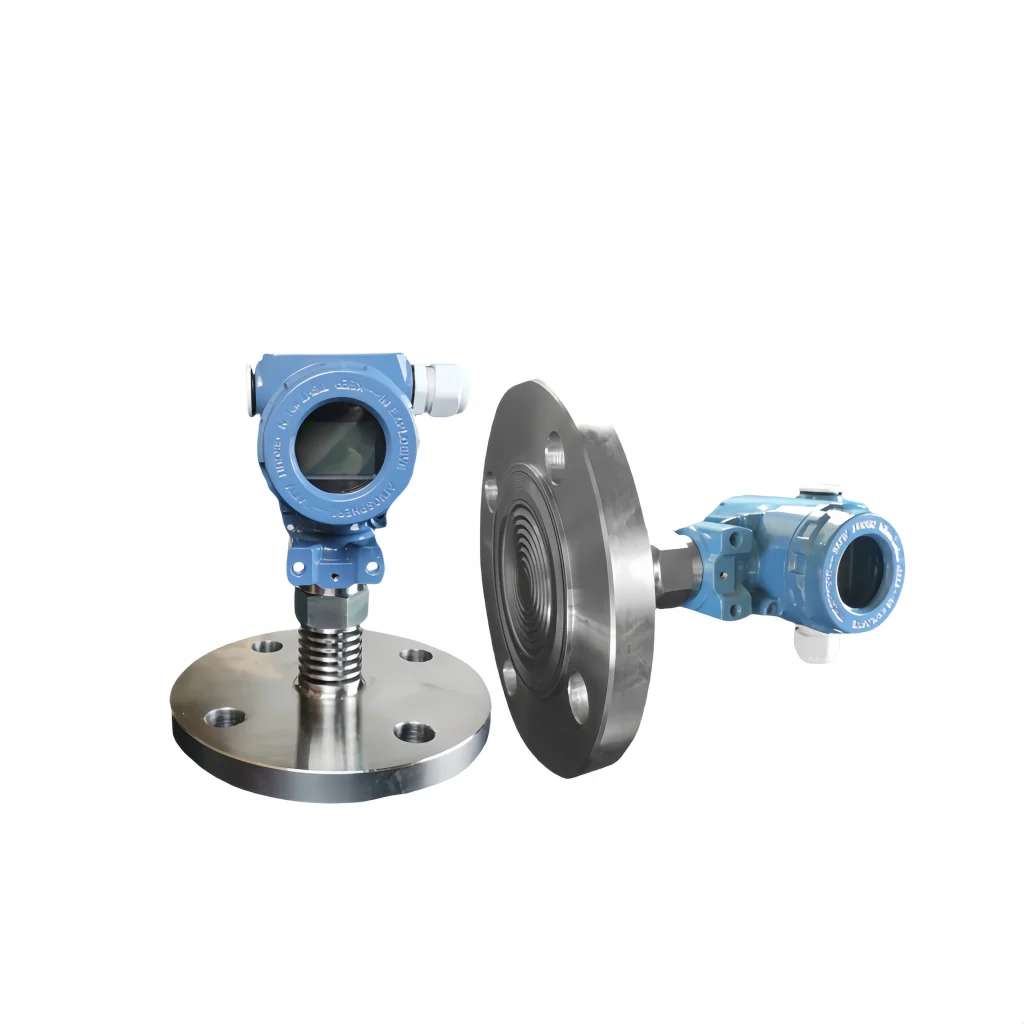
The measurement principles of the two are fundamentally different: magnetostrictive transmitters calculate level based on magnetic fields and wave velocity, whilst differential pressure level transmitters convert level using the hydrostatic pressure formula P = ρgh. In terms of accuracy, magnetostrictive sensors have an error range of ±0.1–1 mm, whilst differential pressure level transmitters have an error range of ±0.1%–0.5% FS.
In terms of compatibility with different media, magnetostrictive level transmitters are ideal for clean, low-viscosity liquids. In contrast, capacitive level transmitters are more versatile, as they can measure both conductive and non-conductive liquids, as well as viscous liquids and powdered materials. Functionally, magnetostrictive sensors support interface measurement, whereas differential pressure level transmitters do not.
When it comes to the best uses for each, magnetostrictive level transmitters are perfect for accuracy, interface measurement and long-term stability, while differential pressure level transmitters are a general-purpose choice for industrial applications where cost is a factor, especially in sealed vessels where you need to measure both pressure and liquid level at the same time.
Magnetostrictive vs Capacitive Level Transmitters
The two operate on distinctly different principles: Magnetostrictive transmitters use magnetic fields and wave velocity to work, whereas capacitive level transmitters measure changes in capacitance caused by changes in the level of liquid. In terms of accuracy, magnetostrictive transmitters offer a significant advantage, with an error range of ±0.1–1 mm, whereas capacitive level transmitters have an error range of ±1%–3% FS.
In terms of compatibility with different media, magnetostrictive level transmitters are ideal for clean, low-viscosity liquids. In contrast, capacitive level transmitters are more versatile, as they can measure both conductive and non-conductive liquids, as well as viscous liquids and powdered materials.
Magnetostrictive transmitters can withstand a lot of interference, whereas capacitive level transmitters can be affected by factors such as the dielectric constant of the medium, scaling, and temperature. This can make it more difficult to achieve stable measurements.
Magnetostrictive vs Magnetic Flip-plate Level Gauges
Both involve floats and magnetic fields, but their functional roles differ significantly. In principle, magnetostrictive gauges rely on magnetic fields and torsional waves for measurement, whilst magnetic flip-plate level gauges utilise a float with a magnet to drive the flip-plate, providing on-site display.
In terms of accuracy, magnetostrictive gauges have an error margin of ±0.1–1 mm, whereas magnetic flip-plate level gauges have an error margin of ±5–10 mm. Magnetostrictive level transmitters can send 4–20 mA and digital signals straight away over a distance, which supports remote monitoring. In contrast, magnetic flip-plate level transmitters only display the level locally and require an additional remote transmission module for remote monitoring.
Magnetostrictive level transmitters are great for high-precision remote monitoring and measurement, while magnetic flip-plate level transmitters are better for direct on-site reading, particularly for clean liquids and atmospheric pressure. They are also usually cheaper.
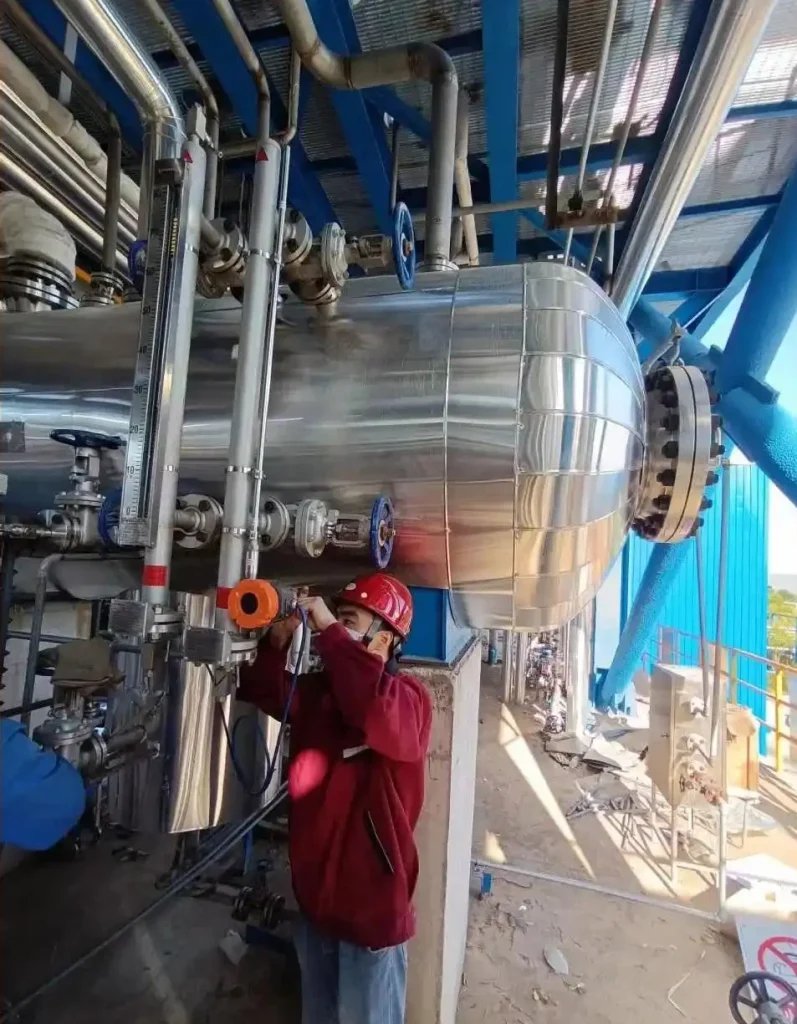
Sino-Inst uses its well-developed research and manufacturing skills to provide top-performing magnetostrictive level transmitters to clients in different industries. It’s also got a full range of industrial measurement and control products, covering level, pressure and temperature measurement and control.
As well as magnetostrictive level transmitters, we offer lots of other ways to measure levels. These include hydrostatic, radar and ultrasonic types. We can adapt our level measurement solutions to suit our clients’ specific needs, including how accurate they need to be and how much they want to spend.