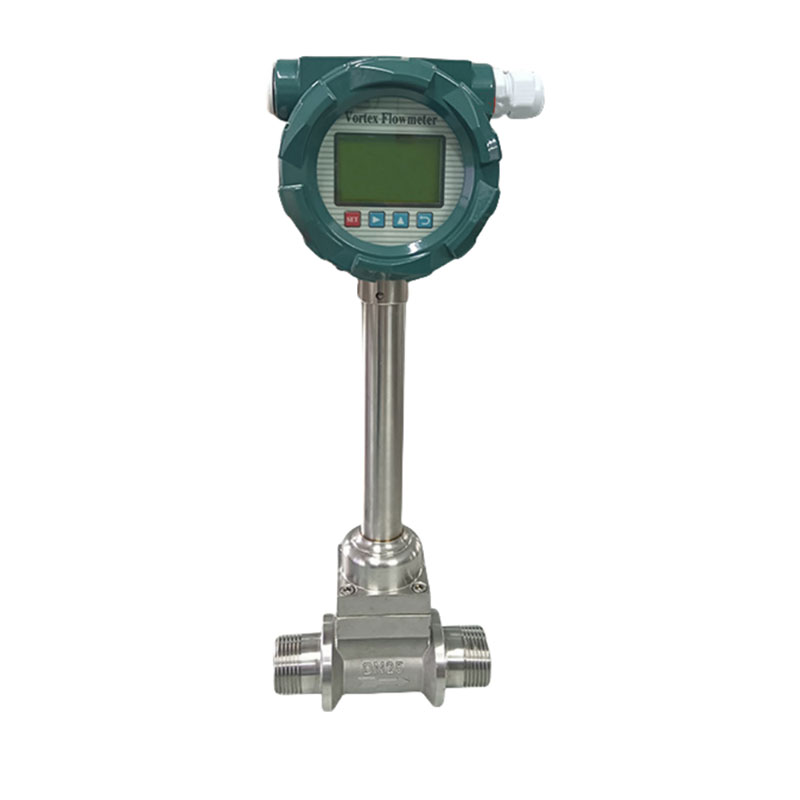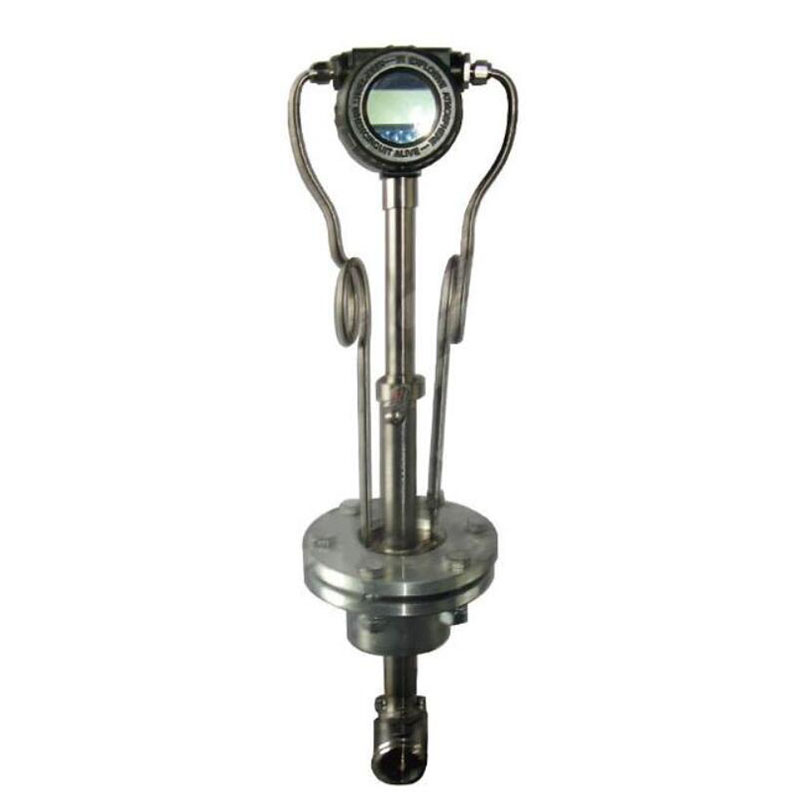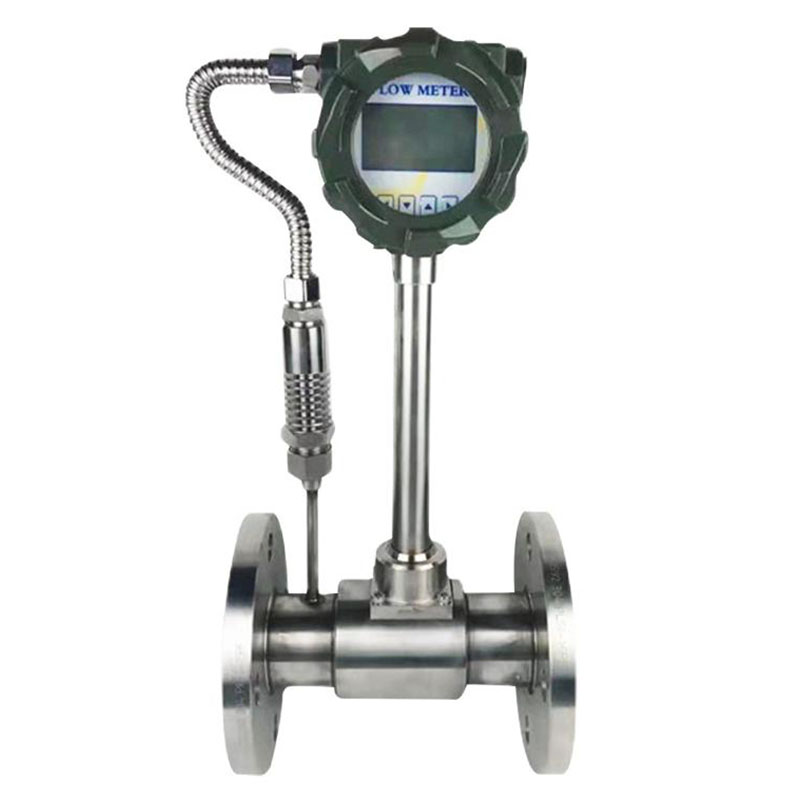
Vortex flowmeters are one of the most important tools for measuring fluid flow, and they’re used a lot in industrial automation, the petrochemical industry, metallurgy and other sectors. The accuracy of their measurements directly impacts how efficiently they can produce things and the quality of the end product. Calibration is a really important step in making sure the data from vortex flow meters is reliable.
Working Principle of Vortex Flow Meters
The basic idea behind vortex flowmeters is based on something called the Karman vortex street effect. When a fluid passes through the meter, changes in its speed create swirling patterns upstream of the sensor. The frequency of these vortices depends on the velocity of the fluid. The flow meter works out the flow rate by detecting these frequencies. So, anything that affects how often vortices are generated might mess up the measurement, meaning you’ll need to calibrate it.
Zero Calibration
The Importance of Zero Calibration
The great thing about zero calibration is that it makes sure the flowmeter’s output signal reads zero when there’s no fluid flowing through it. Any zero-point offset in a vortex flowmeter directly causes measurement errors, compromising the instrument’s accuracy. These offsets can be caused by things like changes in the environment, sensor wear and tear, or if they haven’t been installed properly. So, regular zero calibration basically makes sure that vortex flowmeters are accurate and reliable.
Steps for Zero Calibration of Vortex Flow Meters
Ensure the flow meter is stationary: Before you do the zero calibration, make sure the fluid you’re measuring has stopped flowing and the equipment is stable.
Select appropriate calibration tools: You can compare it to an external standard flow source, or you can use a calibration device provided by the manufacturer. Ensure the tools used possess high precision and comply with relevant standards.
The output signal of the vortex flow meter should be compared to the zero-flow signal from the standard flow source. This will cause the meter’s output to approach zero.
Adjust zero offset: If you see a shift of zero, either use the device’s adjustment feature or change the settings for the sensor.
Verify calibration effectiveness: Following zero adjustment, conduct a re-verification. Ensure the vortex flow meter’s readings align with the standard flow source to confirm successful calibration.
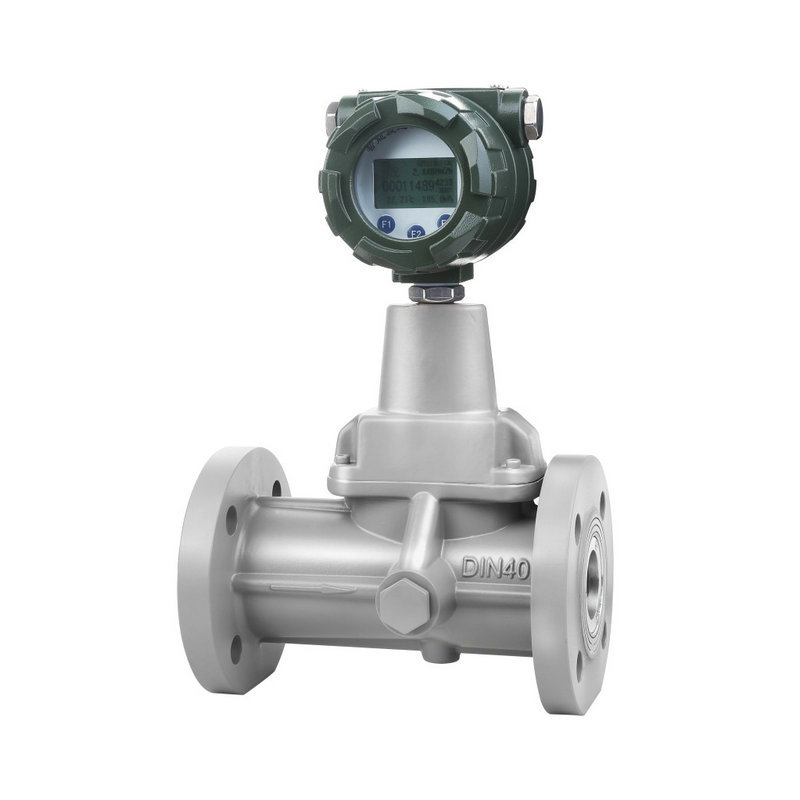
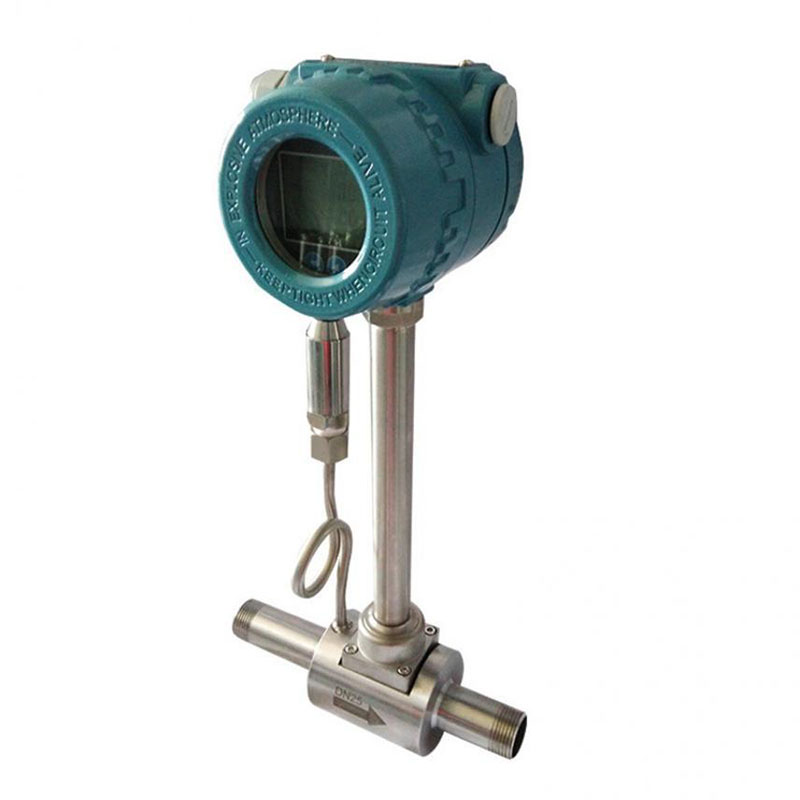
Calibration
The Importance of Calibration
In real-world situations, vortex flow meters can gradually become less accurate for a variety of reasons, including external factors, pipeline vibrations and changes in the substance being measured. Calibrating the flow meter fixes any errors, providing more accurate readings. This provides reliable information for controlling and managing the production process.
If you calibrate it regularly, you can spot any potential problems as they come up, like sensor damage or circuit faults. If you get these problems sorted quickly, you can stop them getting worse over time, which means the flowmeter will last longer and you’ll spend less money on replacing equipment.
Calibration Methods for Vortex Flow Meters
1. Static Calibration Method: This approach is suitable for low flow rates. First, install both the vortex flow meter and a standard flow meter concurrently on the same pipeline. Subsequently, compare the measurement results from both instruments to calculate the deviation and accuracy of the vortex flow meter.
2. Dynamic Calibration Method: This method is applicable for high flow rates. First, a stable flow pump supplies fluid to both the vortex flow meter and the standard flow meter. Subsequently, by comparing the measurement results from both instruments, the deviation and accuracy of the vortex flow meter are calculated.
3. Online Calibration Method:This method is great for situations where you need to do a lot in real time. If you install a vortex flow meter and a standard flow meter at the same time on the pipeline and connect them to a central control system, the central control system can monitor and compare both meters in real-time, which means you can calibrate them online.
Advantages and Disadvantages of Calibration Methods
1. The static calibration method is simple and easy to use, you can do it on-site, and it doesn’t require any specific fluid velocity. The problem is that it’s only suitable for low-flow scenarios, so it’s not great for high-flow conditions.
2. The dynamic calibration method is better because it works better with high flow rates and gives more accurate calibration data. However, it needs a stable flow pump and difficult testing conditions, so it can’t be used in the field.
3. The great thing about the online calibration method is that it provides accurate and reliable calibration results through real-time monitoring. The system is a bit complex, costs more, and there are strict rules about the instruments and equipment needed.
Calibration Procedure
Vortex flowmeter calibration primarily employs the comparison method, wherein instrument readings are verified against standard apparatus or flow standard substances with known flow rates. The specific procedure typically encompasses the following steps:
1. Select Calibration Equipment and Environment
First, you need to pick the right equipment for the job. The usual calibration equipment you’d find includes standard flow meters or liquid calibration devices. The calibration environment should be set up to copy the flow meter’s real-world conditions, as things like temperature, pressure, and fluid type can affect the accuracy of the measurements.
2. Setting the Flow Range
During calibration, the flow meter’s operational range must be defined, typically covering multiple points from zero flow to maximum flow. This process assesses the vortex flow meter’s response across varying flow rates, ensuring measurement accuracy throughout the range.
3. Adjusting the Vortex Flow Meter
You can adjust the vortex flow meter with the standard equipment. Then compare the flow meter’s measured values with the standard equipment’s flow values, and adjust the vortex flow meter’s output signal. Just to flag, the flow meter usually gives off a frequency or pulse signal, so keep the signal steady when you’re doing the calibration.
4. Multi-Point Calibration and Accuracy Verification
To make sure it works properly at different flow speeds, it needs to be checked at several points during the calibration process. If you check at lots of different places, you can spot mistakes and fix them. This makes sure that the vortex flow meter is accurate when used in the real world.
5. Recording and Updating Calibration Data
After each calibration, all the relevant data must be documented carefully. This includes readings from the standard flow equipment, the vortex flow meter, measurement errors and calibration results. These records are really important for keeping an eye on the maintenance and servicing of the equipment.
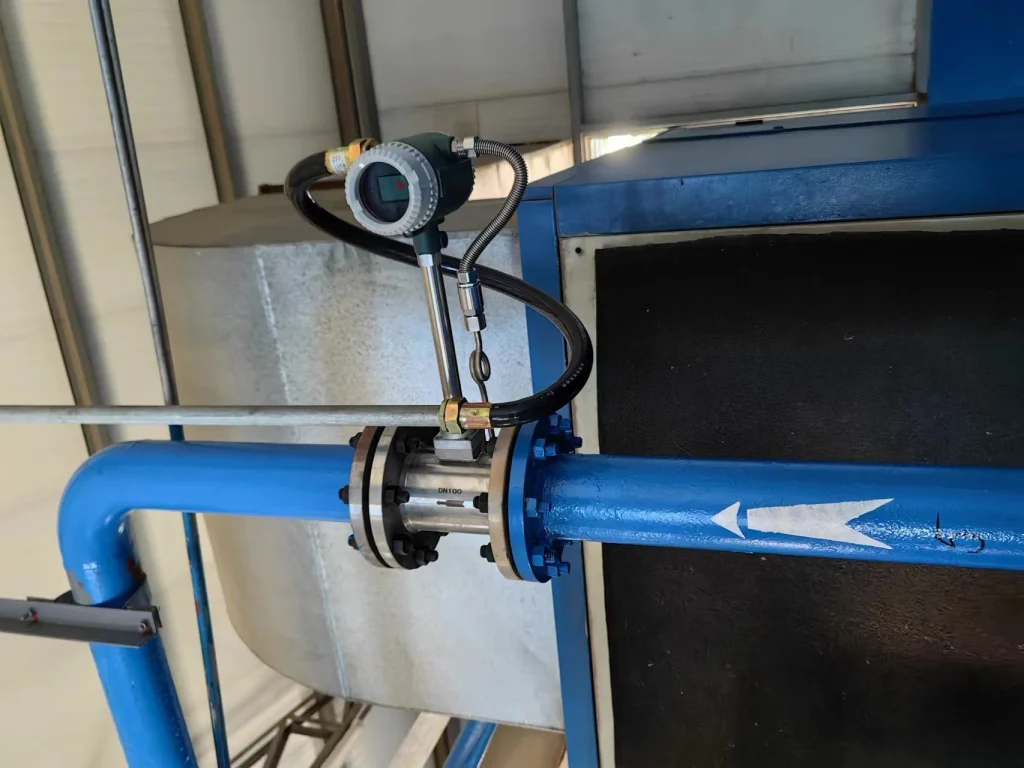
Factors Affecting the Accuracy of Vortex Flow Meters
Fluid Characteristics-Related Factors
Reynolds Number Range: Vortex flow meters must operate within an appropriate Reynolds number range (typically 10,000–20,000). Exceeding this range disrupts the linear relationship between vortex formation and flow velocity, leading to a significant decline in measurement accuracy.
Multiphase Fluid Characteristics: Gas-liquid, liquid-solid, and other multiphase flows severely disrupt vortex formation, causing measurement errors substantially greater than in single-phase fluids. The extent depends on phase proportions, solid particle size, and other factors.
Temperature and Pressure: Fluctuations in temperature and pressure alter gas and vapour densities. Failure to compensate for temperature leads to mass flow measurement deviations; high temperatures may also impair instrument component performance.
Installation Factors
Insufficient straight pipe length: Failure to meet upstream (recommended 15-20 pipe diameters) and downstream (5-10 pipe diameters) straight pipe requirements causes flow field irregularities.
Inappropriate installation locati0n and orientation: Proximity to vibration sources or strong electromagnetic interference zones causes signal fluctuations or renders measurement impossible. Incorrect installation orientation may cause liquid or gas accumulation, increasing errors by 10%-20% and potentially damaging the instrument.
Instrument-Specific Factors
Vortex generator precision and condition: Inadequate shape or dimensional accuracy of the generator, or wear, deformation, and surface roughness during use, alter vortex characteristics, causing measurement errors of up to 5%-10%.
Sensor performance and stability: Inadequate sensor sensitivity, resolution, or linearity, or component ageing and temperature drift after prolonged use, may cause errors of 3%-10%, with inaccuracies increasing over time.
Signal processing and conversion circuit precision: Insufficient precision in circuit filtering, amplification, or analogue-to-digital conversion stages may cause signal distortion, introducing measurement errors of 2%-5%.
FAQ
Nearly all flow meters require straight pipe sections. What is the fundamental reason for this?
Flow meters require a fully developed, uniform flow field. Insufficient straight pipe sections and fittings such as elbows, valves and pump bodies at the start and end of the pipe can cause problems such as turbulence, flow deviation and backflow. This can interfere with the flow meter’s reading, making it much less accurate. Conventional requirements stipulate 10–20 times the pipe diameter upstream and 5 times downstream. Vortex and turbine flowmeters demand even greater straight pipe lengths.
How can vibration and electromagnetic interference be mitigated during flowmeter installation?
1. Make sure it is not near things that vibrate, like pumps, motors and compressors. Put vibration-damping pads and flexible connectors in the right places.
2. Make sure you keep it away from things that might cause electromagnetic interference, like frequency converters, high-voltage cables and welding machines. Use shielded cables for flow meter wiring, with the shield grounded at one end only.
3. Vortex and turbine flow meters are more sensitive to vibration; make sure you have strong measures in place to reduce vibration.
What is the difference between the volume flow rate and mass flow rate indicated on flow meters?
Volume flow rate denotes the fluid’s volume under operating conditions, significantly influenced by temperature and pressure. The mass flow rate is the fluid’s actual mass, and it doesn’t change based on the operating conditions. For measuring gases or steam, prioritise flow meters with temperature and pressure compensation for standardised volume flow rate or mass flow rate. For measuring liquids at standard temperature and pressure, an operating condition volume flow rate meter suffices.
Sion-Inst specialises in flow measurement technology. We rigorously oversee every production and testing stage for each flowmeter. Whether adapting vortex flowmeters for high-temperature/high-pressure conditions, ensuring electromagnetic flowmeters handle contaminated fluids, or facilitating convenient installation of large-bore insertion turbine meters, all undergo stringent testing. This guarantees our products adapt to complex industrial environments and deliver long-term stable operation.