Industrial tanks run in complex environments that create real challenges for level measurement, particularly around resolution and resistance to interference. FMCW radar level sensors handle this through frequency-domain difference demodulation, enabling accurate non-contact detection.
Compared with pulse radar, they offer better signal-to-noise ratio and can reach millimeter precision, so they hold up well in harsh conditions like high temperatures or low dielectric constants. For these reasons, they have become the measurement device of choice in modern automated control systems.
What Is FMCW?
FMCW stands for Frequency-Modulated Continuous Wave—a radar technique that has caught on across a wide range of applications. Instead of firing off discrete pulses, the system sends out a continuous wave and steadily ramps its frequency up or down.
When that wave hits a target and bounces back, the receiver mixes the echo with the outgoing signal, generating a steady beat frequency. The size of that frequency gap maps directly to target distance, and how fast the gap shifts reveals target velocity.
Compared with pulse radar, FMCW has no detection blind spots, consumes little power, resists interference well, and can track multiple targets at once. Its applications span automotive millimeter-wave radar, equipment obstacle avoidance, industrial distance measurement, and human presence detection.
FMCW Radar Level Transmitter
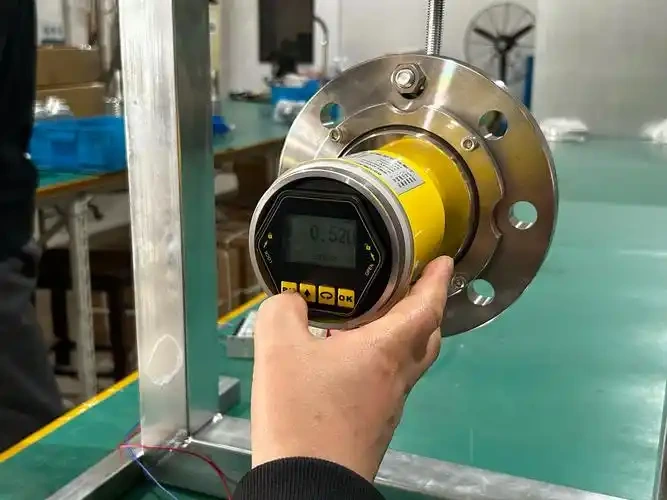
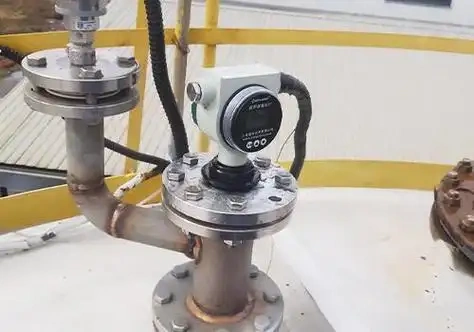
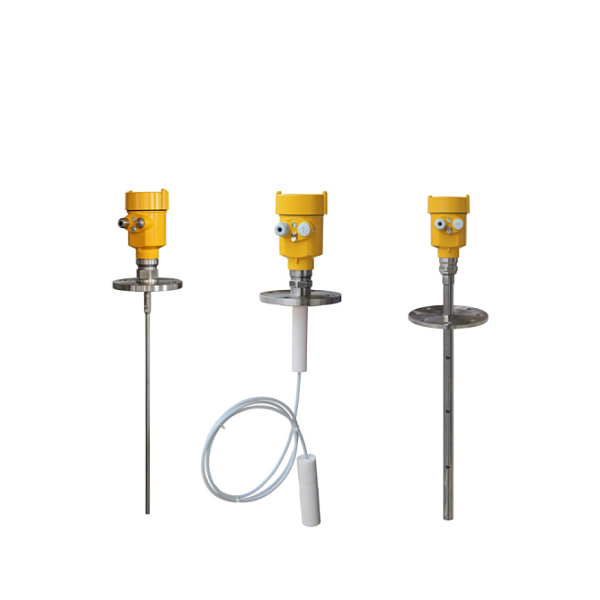
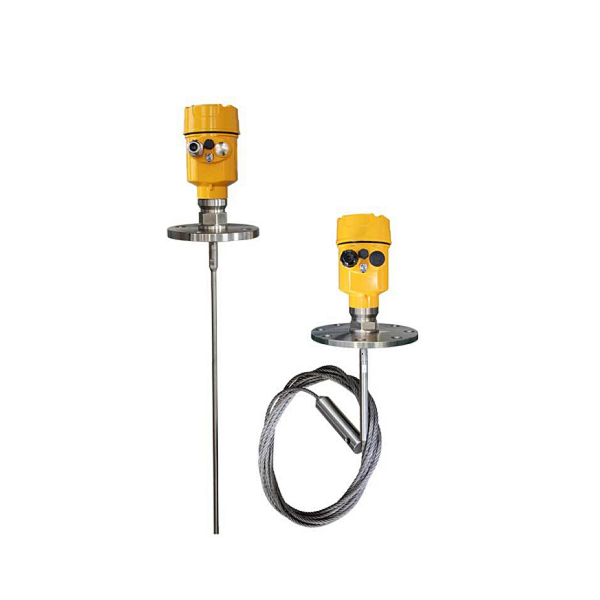
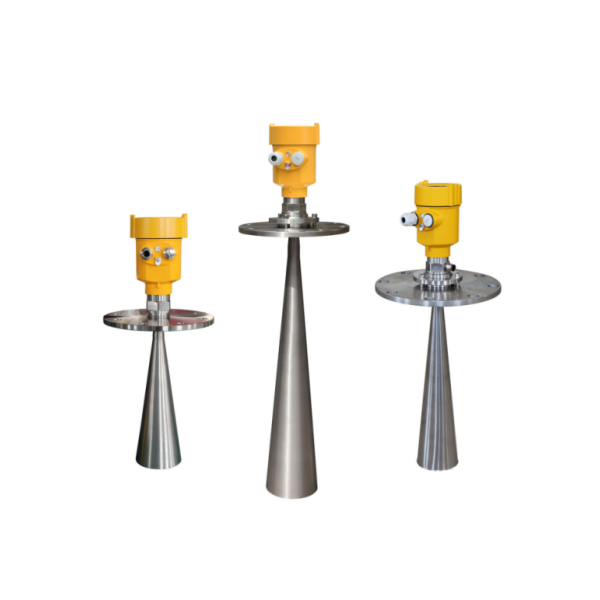
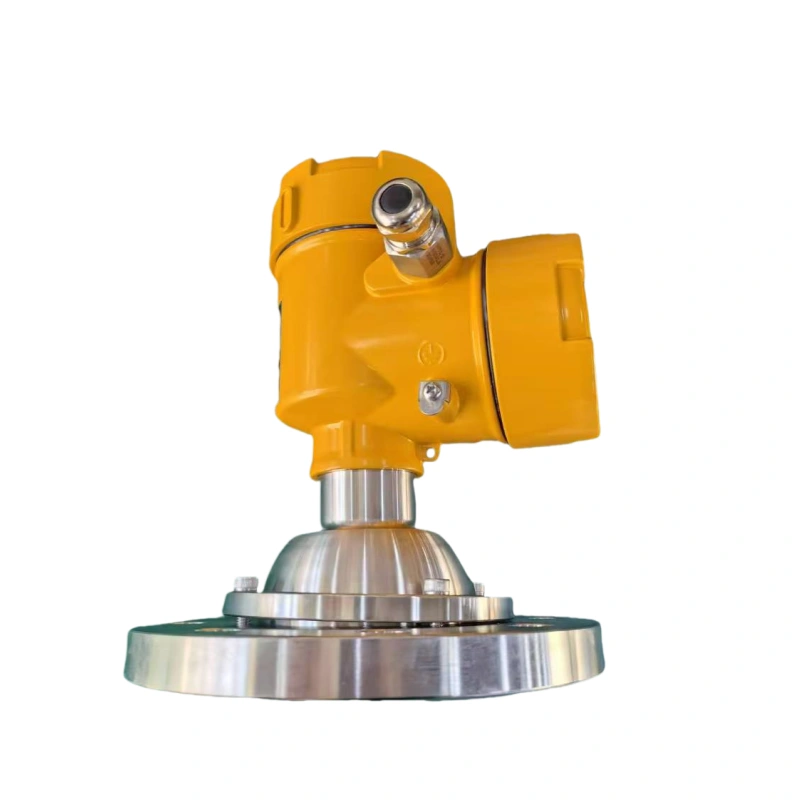
The FMCW (Frequency-Modulated Continuous Wave) radar level transmitter is a non-contact industrial instrument for level measurement, working on microwave frequency-modulation principles.
It fits naturally into storage tanks, reactors, and silos. The hardware brings together an antenna, signal processing, and transmitter modules in one package. You can use it to gauge liquids, slurries, or solid particles, and it stays accurate even when dust, steam, or sharp shifts in temperature and pressure are present.
It covers a broad measurement span with high precision, and since it supports both 4–20 mA and Modbus outputs, tying it into automated control systems is straightforward. If the site calls for it, explosion-proof and corrosion-resistant versions are also on offer. Typical settings include chemical processing, oil and gas, and water treatment.
Working Principle
An FMCW radar level transmitter measures distance by emitting a microwave signal that is continuously modulated with a linear frequency ramp. The antenna sends out high-frequency electromagnetic waves that steadily climb in frequency over time. These waves move downward, strike the surface of the measured medium, and return to be captured by the same antenna.
At this point, there is a fixed frequency difference between the transmitted and received signals. This frequency difference has a linear relationship with the round-trip distance of the electromagnetic waves.
The internal signal processing circuit acquires the frequency difference value and, by combining it with the speed of electromagnetic wave propagation and dielectric compensation parameters of the medium, accurately calculates the real-time distance from the antenna to the surface of the material.
After the total tank height is calibrated through the built-in parameters, the system automatically determines the actual liquid level. The reading is then converted into a standard electrical signal and sent out.
Unlike pulse-type radar, the frequency-modulated continuous-wave (FMCW) signal consumes less power and delivers a higher signal-to-noise ratio, so the measurement stays stable even with low-dielectric media, thick foam, or heavy dust in the environment.

Advantages of the FMCW Radar Level Transmitter
1. No physical contact with the material.Because the sensor never touches the process media, you avoid the usual headaches of probe corrosion or material caking and clogging. It works reliably over long periods with aggressive chemicals, thick slurries, and media that tend to crystallize.
2. Tough against environmental interference.Dust, steam, foam, and swings in temperature or pressure do not throw off the reading. It keeps measuring steadily even in tricky conditions like low-dielectric liquids or solid silos.
3. High accuracy across a wide span. Whether you are looking at a small storage tank or a towering silo hundreds of meters tall, it delivers precise, real-time, continuous level data.
4. Simple to integrate. With 4–20 mA and Modbus outputs built in, it drops straight into existing PLC and DCS architectures for remote monitoring and automated control.
5. Plenty of models to match the job. Explosion-proof and corrosion-resistant variants are available, along with different antenna styles, so it fits right into harsh settings like chemical plants, oil and gas facilities, wastewater treatment, and grain processing.
6. Better all-round performance than pulse radar.It runs on lower microwave power yet pulls in a stronger signal-to-noise ratio, which means smaller errors and steadier readings when thick foam or heavy dust are present.
Application Scenarios
1. Petrochemicals:
In petrochemical plants, these transmitters handle crude oil, refined products, and chemical solvents stored in bulk tanks. Because the measurement never touches the fluid, oil vapors and mist do not throw off accuracy, and the explosion-proof housing lets the unit run safely in hazardous areas.
It tracks both liquid level and the oil-water interface with tight precision, feeding that data straight into the plant control system for inventory counts, live monitoring, and alarm trips whenever levels drift out of range—keeping the operation safe.
2. Municipal Water Treatment:
Wastewater treatment plants put these units to work across a range of tanks. The signal gets through surface foam and suspended solids without issue, and with a corrosion-resistant antenna installed, it handles aggressive effluents just fine.
It tracks liquid level and sludge interface reliably, works alongside pump sets to balance inflow and outflow automatically, and it keeps running even when outdoor conditions get rough.
3. Power Generation:
At thermal power stations, you will find them on deaerators, flue-gas desulfurization towers, and chemical storage tanks. The antenna design resists buildup and acidic or alkaline spray, so scaling and water mist do not degrade performance.
It measures without blind spots in hot, pressurized, sealed vessels, catching high-level and dry-run conditions before they cause damage and trip the unit.
4. Grain, Oil, and Food:
Food-grade units go into grain and oil silos, plus tanks for edible oils and dairy. No probe touches the product, so contamination is not a concern, and the design meets hygiene standards. It reads through dust, foam, and bridging arches, handling both liquid and solid level measurement to support smart warehouse management in the food sector.
5. Mining and Cement:
Fly ash silos, cement silos, and ore hoppers are typical high-dust homes for these devices. The radar signal punches through dense dust to lock onto the material surface and deliver a solid level reading. By coordinating with conveyor systems, it helps prevent blockages and the downtime that comes from running a silo empty.
6. Pharmaceuticals and Fine Chemicals:
Reactors and crystallizers—sealed, pressurized equipment—are where these compact, easy-to-mount transmitters shine. They compensate for level swings and foam created by agitators, and their explosion-proof, cleanroom-compatible construction keeps feed levels right where they need to be for a steady batch or continuous process.
7. Water Resources and Hydrology:
Out in the open at reservoirs, rivers, and holding basins, weatherproof, watertight, and lightning-protected housings keep the electronics safe. Surface waves and floating debris do not disturb the reading, and low-power designs allow solar supply with remote telemetry, feeding data straight into flood-warning systems and water-allocation planning.
8. Marine, Coal Chemical, and Cold Chain:
Marine-rated units shrug off salt fog and sloshing liquid surfaces, carry the required maritime explosion-proof certification, and help maintain proper load balance on board.
In coal-chemical plants, they tolerate extreme heat and pressure while ignoring coal dust and tar mist, so production keeps running. In cold-chain facilities, they keep an eye on low-temperature refrigerant levels and catch problems before they lead to equipment shutdowns.
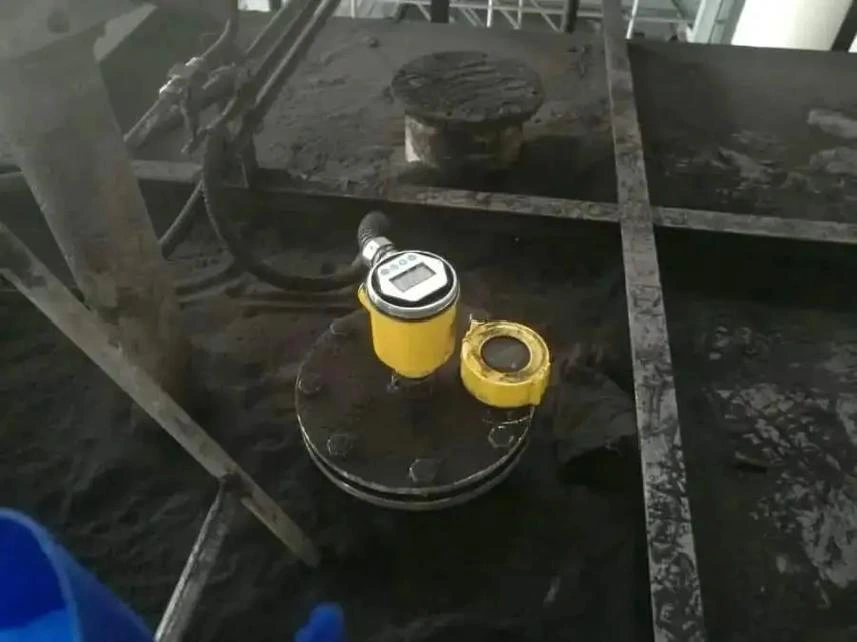
Differences Between FMCW and CW
1. Different signal modulation methods:
CW (Continuous Wave) puts out a signal on one fixed frequency—the transmission never shifts during operation, so the signal stays dead simple with no sweep involved.
FMCW takes a different approach: the transmission frequency climbs and falls in a linear ramp over time. Because it actively sweeps across frequencies, it generates a wideband signal carrying much more information than plain CW, which explains why the two end up performing so differently in the field.
2. Different ranging principles:
CW radar measures by looking at the phase difference between the transmitted and received signals. That approach gives you the relative position of a target, but it cannot pin down the absolute distance.
FMCW radar calculates distance from the frequency difference between the transmitted and received signals, converting the target’s position through a stable modulation curve. The math is cleaner and the data tracks better.
3. Differences in Measurement Accuracy and Blind Zones:
Up close, CW signals overlap, creating large dead zones and lower accuracy—fine for some jobs, but not precise enough for demanding industrial measurement.
FMCW uses well-developed demodulation algorithms, keeps dead zones to a minimum at close range, and holds steady across short and long distances alike. Its resolution and repeatability are well ahead of conventional CW radar, so it fits tanks and equipment of any size.
4. Differences in Multi-Target Recognition Capabilities:
CW radar cannot tell apart multiple reflections coming back along the same path. When there is oil sitting on water, foam on the surface, or tank fittings in the way, signals get muddled and readings bounce around.
FMCW radar reads the frequency differences in the returning echoes to separate layered targets—liquid surface, interfaces, tank bottom—so it handles aliasing much better.
5. Differences in Environmental Interference Resistance:
CW’s fixed-frequency signal picks up interference from other gear running on the same frequency, and from steam, dust, and foam in the air. That kind of noise is hard to filter, so stability suffers in messy conditions.
FMCW’s broadband swept signal filters noise far more effectively, pushing through fog, dust, and liquid surface turbulence. It holds up in harsh industrial settings like chemical plants, power stations, and wastewater facilities.
6. Differences in Hardware Cost and Applicable Scenarios:
CW systems are cheap and simple to build, but they only really work for basic speed checks or simple level monitoring where conditions are clean.
FMCW hardware folds in modulation and demodulation modules, which makes the unit more complex and expensive. In return, you get all-round measurement performance, which is why it has become the go-to choice for high-precision industrial level measurement.
FMCW Radar Level Sensor vs. Pulse Radar Level Sensor
1. Differences in Operating Principles:
FMCW radar puts out a continuous microwave signal whose frequency sweeps in a straight line. It works out liquid level from the frequency gap between what it sends and what comes back, and the signal never drops out.
Pulse radar, on the other hand, runs in bursts—it shoots short microwave pulses and figures distance from how long each echo takes to return. The signal comes and goes, and the basic mechanism is more straightforward.
2. Measurement Accuracy and Stability:
FMCW radar grabs a wide bandwidth and samples at a high rate, so it picks up small level changes easily and keeps readings steady. Even when the liquid surface has slight ripples, the data holds up and drift is hardly an issue.
Pulse radar samples slower and its pulses carry less power. When levels move a little, accuracy slips, the readings pick up more noise, and the overall error margin ends up wider.
3. Blind Zones and Measurement Range Performance:
FMCW radar leans on mature demodulation algorithms, leaving almost no dead zone near the antenna. It handles short-range jobs like small reactors and slim tanks just as well as long-range measurements in big storage vessels.
Pulse radar has a fixed near-range blind zone, and pulse signals are prone to overlap and interference at close range. It is not suitable for high-precision measurements in short tanks or confined equipment but is well-suited for conventional medium- to long-range applications.
4. Interference Resistance and Multi-Target Capability:
FMCW radar tells different reflections apart by their frequency differences, so it can cut through the clutter from foam, dust, steam, and internal tank fittings. It picks out layered targets like liquid surfaces and oil-water interfaces without trouble, which makes it a good fit for messy, demanding process conditions.
Pulse radar has a harder time separating overlapping echoes. Foam and dust hit it harder, and readings tend to jump around. It really only works well when there is a single medium and the environment is fairly clean.
5. Hardware Costs and Application Scenarios:
Pulse radar keeps things simple on the circuit side, draws little power, and offers good value for the money. You will see it in everyday level monitoring jobs—water treatment, general warehousing—anywhere the conditions are straightforward and free of heavy interference.
FMCW radar packs more hardware and runs more complex algorithms, so it costs more. That extra investment pays off in tough environments where precision matters, which is why it shows up in petrochemical plants, power stations, and fine pharmaceutical manufacturing.
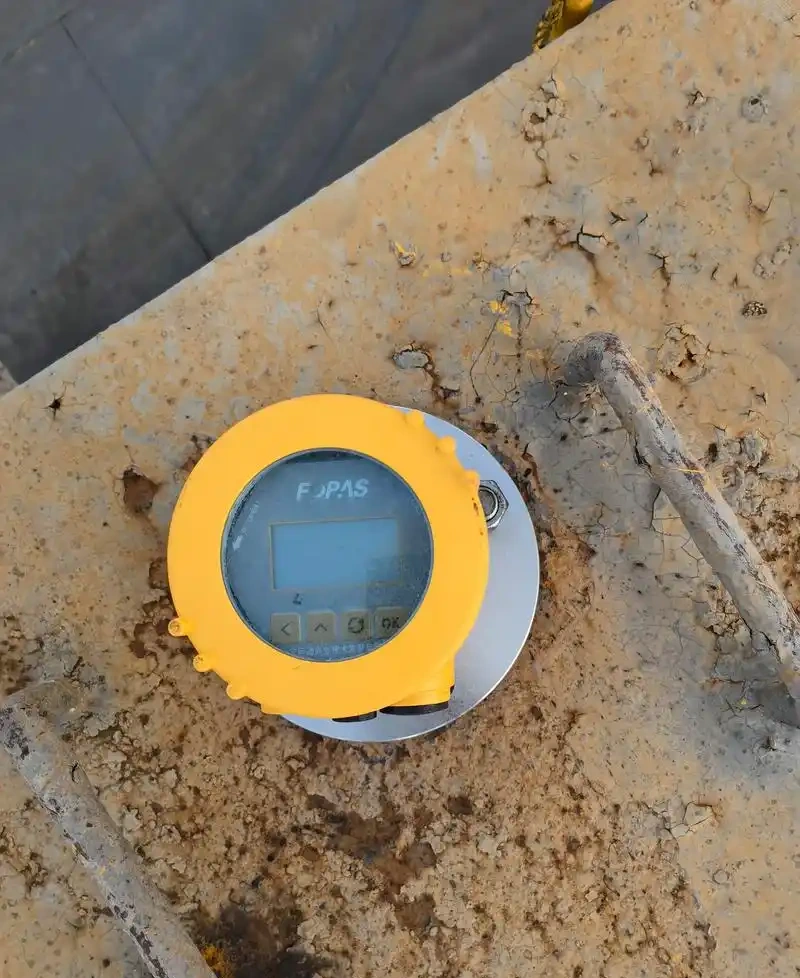
Sion-Inst has spent years working in industrial level measurement and control, building up solid technical expertise and hands-on project experience across many sites. We carry a broad lineup of radar level products and can put together customized solutions that match the specific needs of different industries and tough operating conditions.
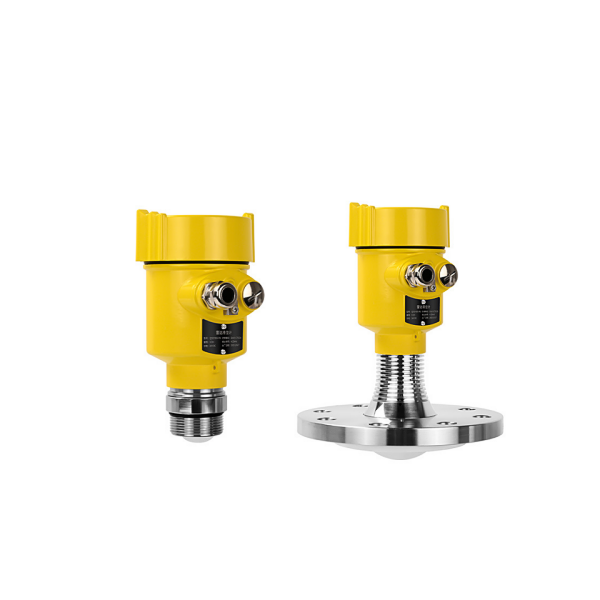
Our 80GHz FMCW radar level sensors deliver accurate readings, hold up well against interference, and have virtually no dead zones. They keep running reliably even when dust, steam, corrosive media, or high pressure are present.
We offer these units in explosion-proof and corrosion-resistant versions, and they talk to all the common industrial communication protocols, so dropping them into existing automation systems is straightforward.
We help customers cut costs and run leaner while keeping production stable. We back that up with quality hardware and solid service. We supply reliable level measurement and control solutions across industries, so plants can keep moving toward automation and smarter operations.