Continuous online water level monitoring is a core component of management and control in water conservancy, municipal pipeline networks and water treatment systems.
Radar water level sensors utilise microwave ranging to achieve non-contact measurement, thereby avoiding the defects of float-type and pressure-type instruments—such as susceptibility to silting and wear—and are suitable for complex water bodies characterised by high or low temperatures and high sediment content.
This article outlines their technical principles, key considerations for operational conditions, and the advantages and disadvantages of their engineering applications, providing a reference for the selection of hydrological monitoring equipment.
What is a Radar Water Level Sensor?
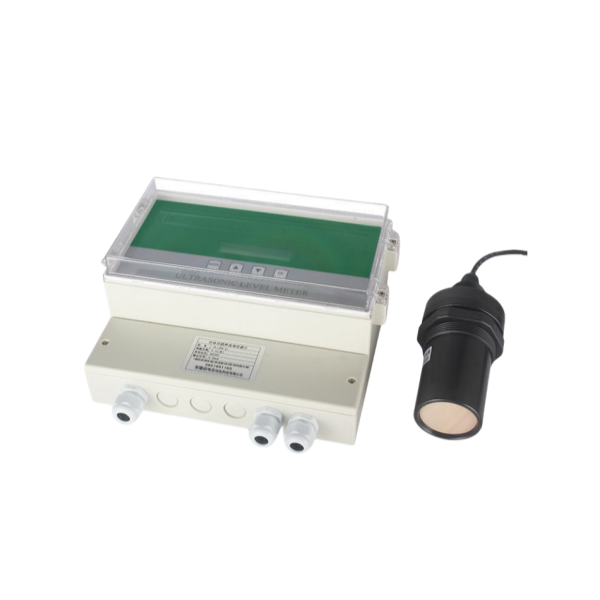
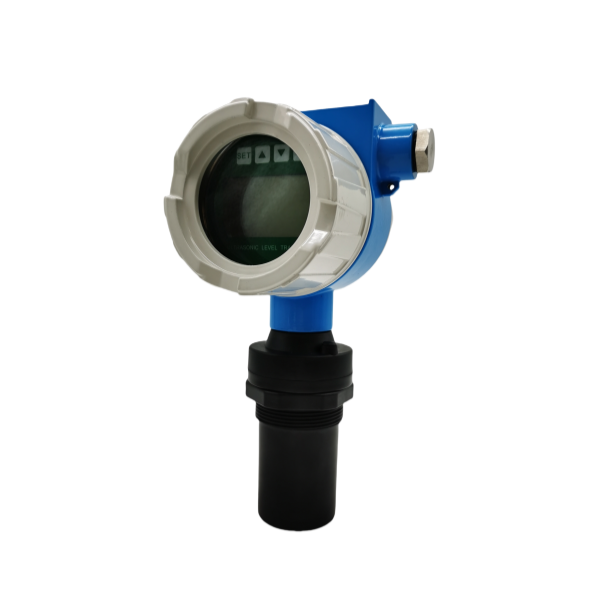
A radar water level sensor is a specialised measuring device used for real-time monitoring of water levels. It is widely used in various water-related environments, including rivers, reservoirs, lakes, sewage treatment tanks, irrigation canals and underground pipe networks.
The device is mounted above the water surface to be measured and can independently collect water level data without coming into contact with the water. It is not affected by conditions such as silt, sewage, floating debris or freezing at low temperatures, and is simple and convenient to maintain.
The device provides a stable output of standardised measurement signals, which can be directly interfaced with data acquisition terminals, industrial control platforms or remote monitoring systems, supporting round-the-clock, uninterrupted online monitoring.
Working Principle of Radar Water Level Sensors
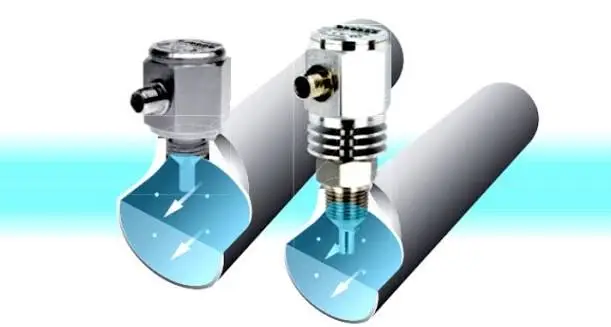
Radar water level sensors measure water levels using high-frequency microwave signals. The device’s antenna transmits radar electromagnetic waves downwards; these waves are reflected upon reaching the water surface, and the echo signals are then received by the antenna.
The sensor’s internal circuitry logs the elapsed time between signal transmission and reception. Using this measurement alongside the fixed propagation speed of electromagnetic waves, it works out the physical distance from the device’s mounting reference plane to the water surface.
That distance is then translated into a live water level reading based on pre-configured installation height settings. The whole sequence runs in a repeating loop, which allows for round-the-clock, uninterrupted water level tracking.

Practical Applications of Radar Water Level Sensors
1. Hydrology and Flood Control:Tracks water levels across rivers, lakes and reservoirs, feeding data upstream as it comes in. Come flood season, the readings on rising and falling water help power early warnings, guide flood control decisions, and feed into risk assessments when things get dicey.
2. Agricultural Irrigation:Set up along canals and at sluice gates, these sensors keep tabs on water levels and team up with gate controllers to fine-tune openings. That means irrigation volumes get dialled in more accurately, water gets shared out more sensibly across farmland, and the whole irrigation network runs with less hands-on intervention.
3. Urban Water Services: Deployed in storm drains, sewage tanks and balancing reservoirs, they watch for water build-up and shifting tank levels around the clock. Catching overflow risks before they become actual overflows keeps the city’s drainage and treatment plants running without hiccups.
4. Water Conservancy Projects:Worked into sluice gates, dams and hydro plants, they keep a steady eye on water levels upstream and downstream. The data they churn out informs gate movements, generation scheduling and how water gets parcelled out, all with the aim of keeping these installations out of trouble.
5. Shipping and Ports: Watches water depth in channels and harbour basins, updating navigable clearance as conditions shift. That heads off the chance of vessels going aground and keeps maritime traffic moving safely.
6. Mine Groundwater Monitoring:Keeps watch over water-filled mine pits and groundwater wells, flagging up what’s happening with water levels as it happens. Getting ahead of pooling and seepage problems before they escalate is what keeps mining sites safe to work in.
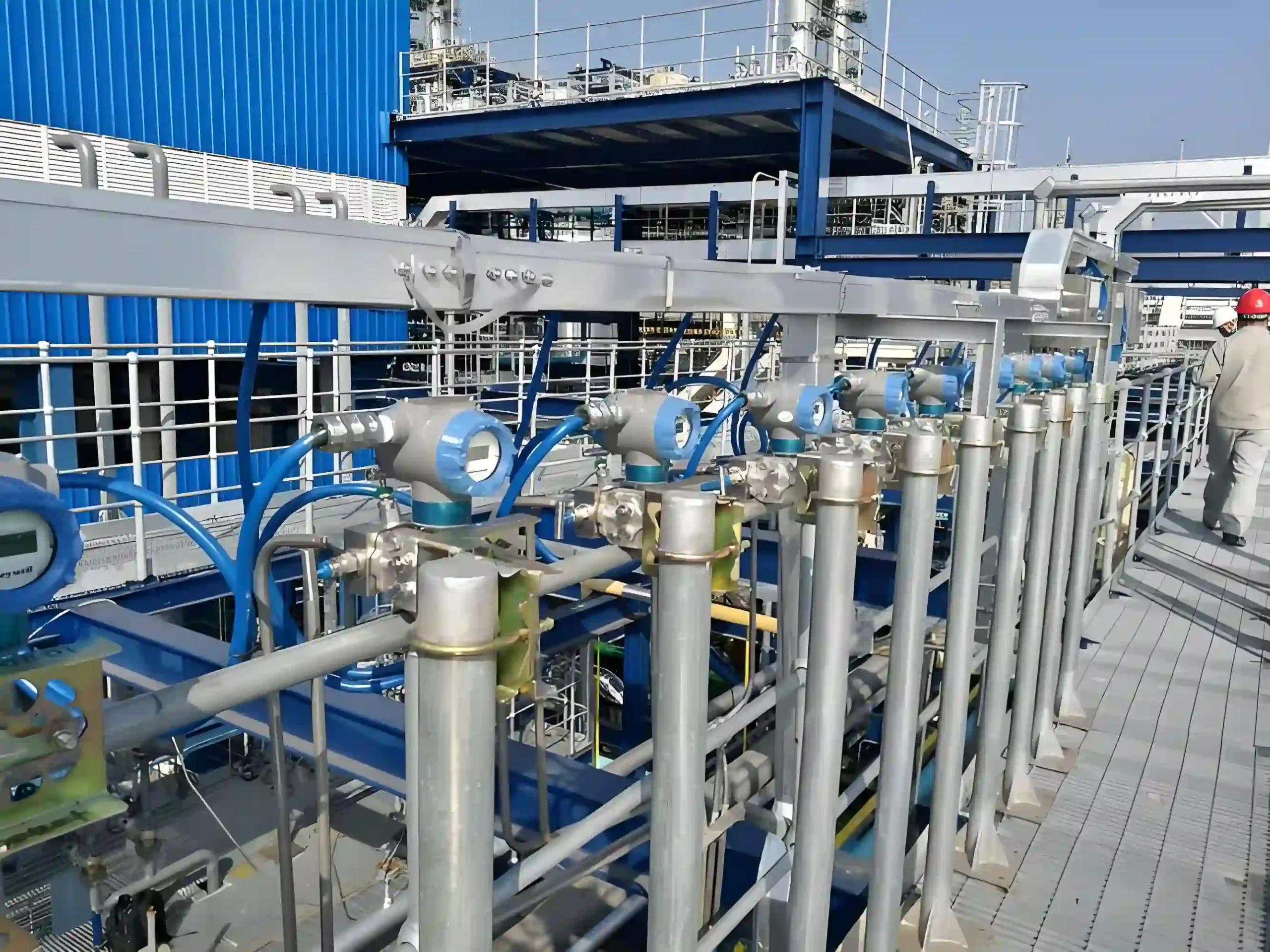
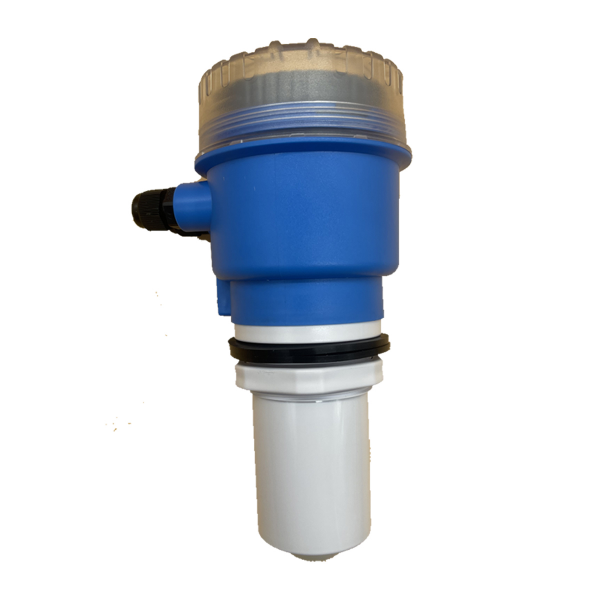
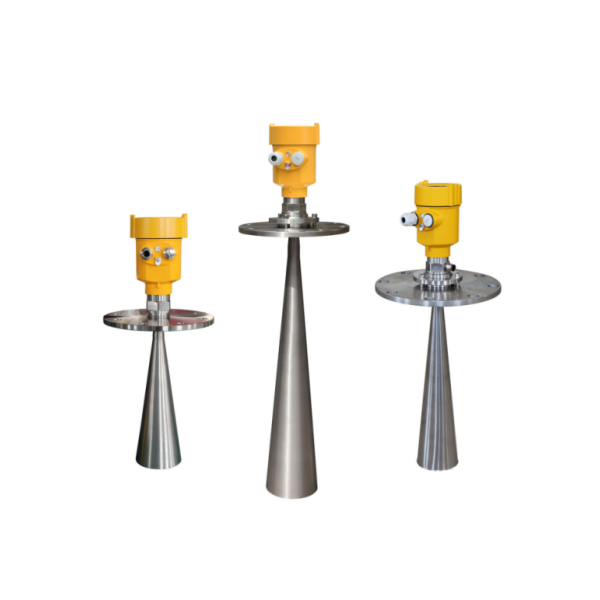
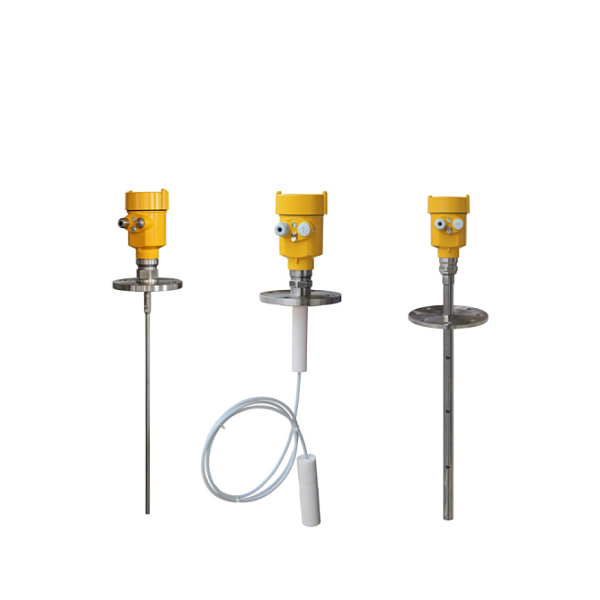
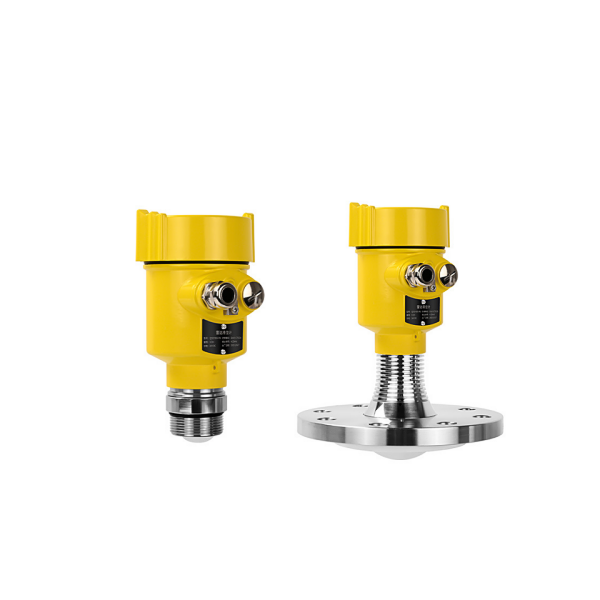
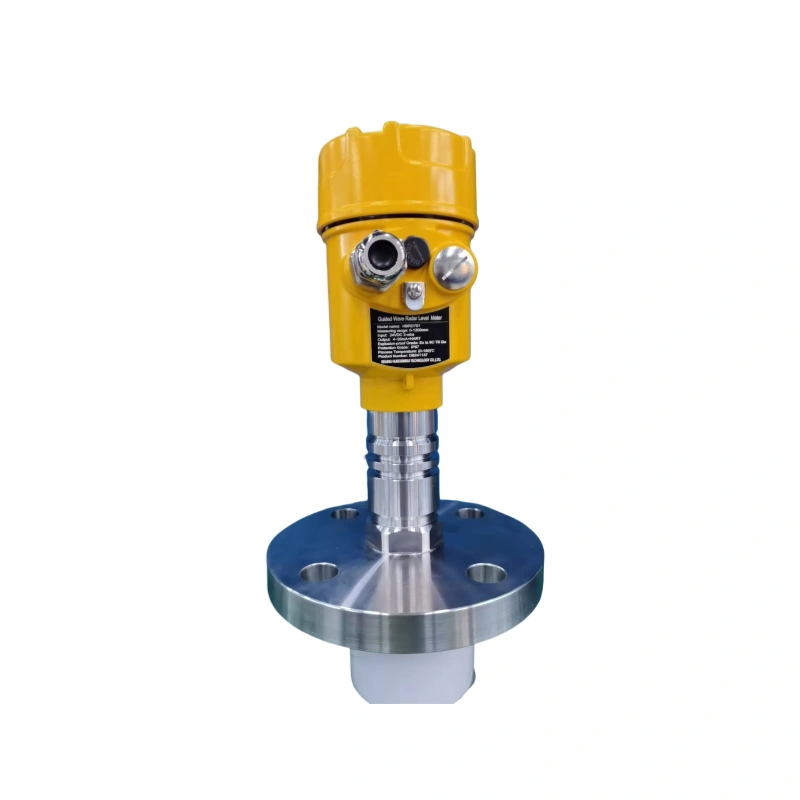
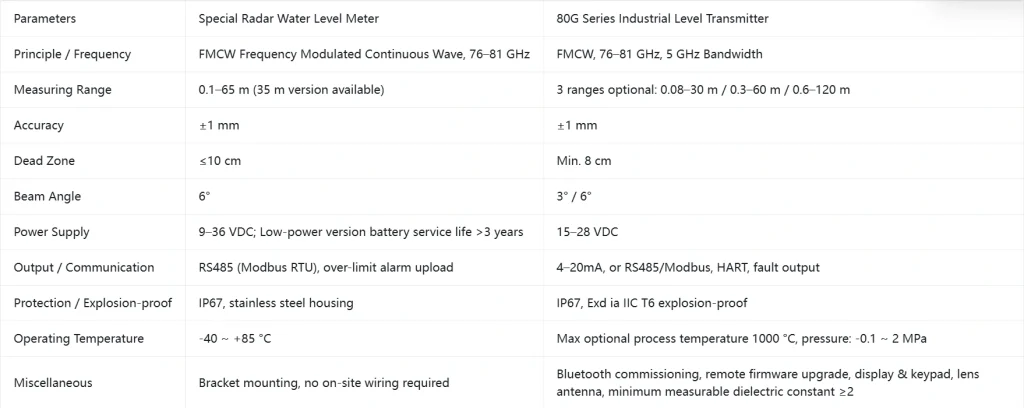
The SIion-Inst's radar level gauge
Advantages of Radar Level Sensors for Water Level Measurement
1. Non-contact measurement: the sensor never actually touches the water, so corrosion, sediment build-up and blockages from sludge or sewage are off the table. It holds up well in water carrying debris, corrosive chemicals or scaling deposits — think sewage, industrial effluent or silty rivers — which translates to a longer working life and far fewer call-outs for maintenance.
2. Water quality and ambient conditions barely register: turbidity, surface foam, vapour, temperature swings and pressure shifts all have next to no effect on how the radar signal gets through. The readings stay rock-solid in tricky environments — extreme heat or cold, high humidity, sealed tanks or reservoirs — giving it a reliability edge over float-type or submerged gauges that can throw a fit under the same stress.
3. It covers a broad span, handling water level checks from tens of metres out:That makes it just as usable in shallow ponds and compact storage tanks as it is in deep-water settings like reservoirs, dams, large sewage tanks and deep boreholes. Positioning is flexible too, with no need to sink hardware deep below the surface.
4. There are no moving parts to wear out or jam:you won’t run into the usual mechanical headaches — floats seizing up, cables snapping, guide rods sticking. It keeps ticking along reliably in long-term, unmanned outdoor setups, which means less time and money spent on upkeep.
5. Fitting it is straightforward and works across a range of layouts:The unit can be fixed above the waterline on tank or reservoir roofs, sidestepping underwater construction work and the hassle of draining the water body later for servicing. It comes in split or integrated configurations and talks to standard outputs like 4–20 mA and RS485, slotting into automated monitoring networks without fuss.
6. The accuracy is tight and the signal resolution is sharp:the microwave radar picks up on even small shifts in water level, which is exactly what’s needed for high-precision data gathering in water resource management, wastewater treatment and storage volume metering.
7. Optional safety and explosion-proof features are available:certain models are rated to explosion-proof standards, making them suitable for water treatment and chemical storage facilities where volatile flammable gases are present. Compared to contact-type sensors, they present lower electrical safety risks.
8. Excellent resistance to environmental interference: strong light, rain, dust and light water mist do not obstruct the radar beam, and long-term use in open-air river channels and open-air reservoirs is unlikely to result in data drift.
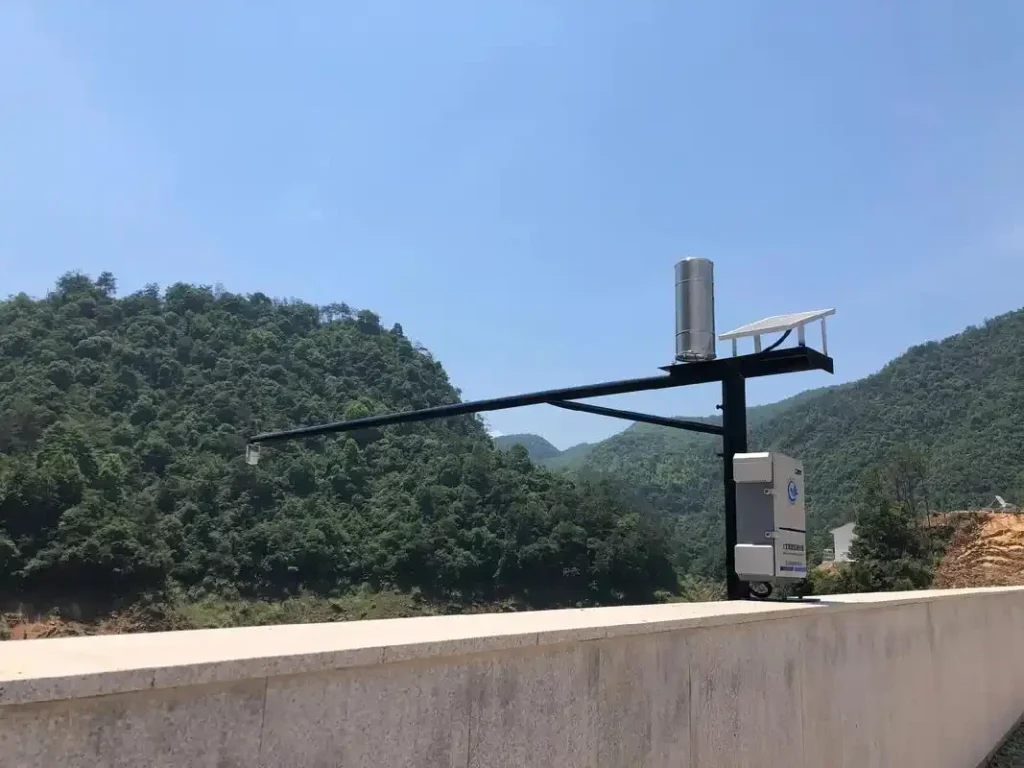
Comparison of Radar Water Level Sensors with Other Water Level Sensors
Comparison with Float-Type Water Level Sensors
Measurement method: Radar employs non-contact measurement, whilst floats operate by being submerged in water and relying on buoyancy; Sediment and viscous impurities in the water can easily adhere to and jam the float, whereas the non-contact nature of radar eliminates issues of blockage or jamming.
Structural failure rate: Floats rely on moving mechanical bits — connecting rods, steel cables, buoys — that wear down, corrode or snap over extended use. Radar has none of that, so breakdowns are far less common and it can run for years without anyone keeping an eye on it.
Media compatibility: Floats tend to corrode and give up in sewage, oily water or anything with harsh chemicals mixed in. Radar couldn’t care less about water quality or corrosion. Floats also struggle in thick, viscous liquids or where heavy foam sits on the surface, whereas radar shrugs off foam interference without much trouble.
Range and installation: Floats are boxed in by limited reach, so deep wells and large reservoirs are no-go zones. Radar sensors can stretch to several tens of metres and mount above the waterline, which means no underwater fitting work and no need to drain the tank when something needs fixing.
Measurement Accuracy: Float-type sensors are essentially on/off devices, so continuous level readings end up rough and imprecise. Radar sensors pump out fine-grained, continuous water level data in real time, which is good enough for metering and proper monitoring.
Comparison with Hydrostatic (Submersible) Level Sensors
Installation and Maintenance: Hydrostatic probes must be submerged to the bottom of the water; cables are prone to ageing and damage due to prolonged immersion, whilst silt can bury the probe, causing data distortion; radar is mounted above the liquid surface, requiring no entry into the water, and cleaning or replacing the equipment is straightforward.
Environmental Interference: Hydrostatic probes are affected by water temperature, water density and sediment accumulation; they may fail outright due to freezing at low temperatures or sludge build-up; Radar microwave signals are unaffected by water density, silt or freezing, offering better stability for outdoor use in winter.
Corrosion Protection: Acidic or alkaline sewage and chemical wastewater can corrode the diaphragm of hydrostatic probes, making probe replacement costly; with radar, only the probe housing is exposed to air, so the medium cannot corrode the core measuring components.
Suitable operating conditions: Hydrostatic pressure gauges fall flat in tanks that dry out or get drained regularly — the probe has nothing to measure once the water’s gone. Radar carries on working whether the tank is full or bone-dry, so it handles wet-and-dry cycles without breaking a sweat.
Explosion-proof applications: Submerged cables are a liability — if they get damaged underwater, electrical leakage is a real risk. Explosion-proof radar sits entirely above the water, keeping well clear of the liquid and offering a safer bet in places where flammable vapour might be hanging around.
Comparison with ultrasonic level sensors
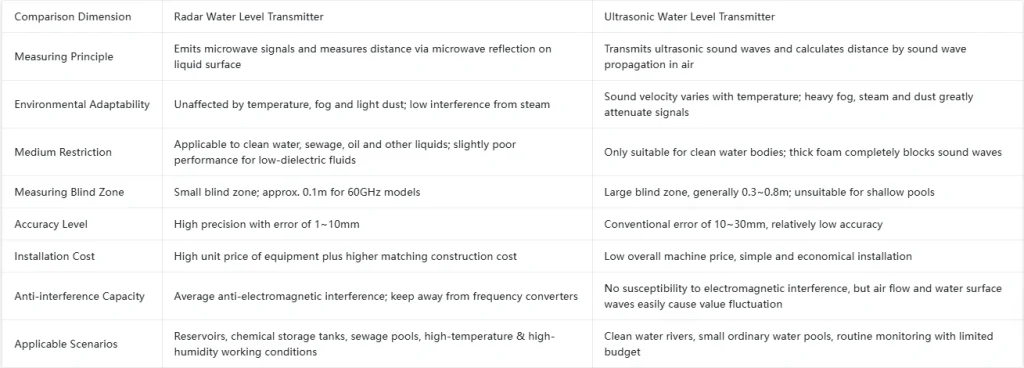
How to Select the Right Water Level Sensor:
FQA
What are the disadvantages of radar level transmitters?
The costs of purchasing and installing the equipment are relatively high, significantly higher than those of ultrasonic and submersible level transmitters;
Low-dielectric media, thick foam, steam and dust can easily weaken the reflected signal, causing fluctuations in readings;
Coils and supports inside the tank can generate false echoes, and commissioning is difficult in narrow tanks;
There are inherent measurement blind spots, and low liquid levels in shallow tanks cannot be monitored;
Strict requirements exist regarding installation verticality and earthing; electromagnetic equipment such as frequency converters can cause drift;
The antenna is prone to crystallisation and material build-up, requiring the installation of purging and trace heating systems; fault diagnosis must be carried out by specialist personnel.
What is the accuracy of radar level transmitters?
The accuracy of radar level transmitters varies by frequency band and product type. Economy-class 24 GHz pulse radar typically has an error of 3–10 mm, with a accuracy class of 0.5;
frequency-modulated continuous-wave (FMCW) radar offers better stability, with accuracy reaching classes 0.1–0.2 and an error of approximately ±2 mm;
60 GHz millimetre-wave radar is optimal for close-range measurement, achieving a maximum accuracy of ±1 mm. The instrument’s nominal accuracy refers only to ideal operating conditions—free from foam, vapour and tank debris.
In the field, where foaming, dust or interference from internal tank components are present, the actual error may increase to 10–30 mm. Digital communication transmission incurs no additional loss, whilst the additional deviation in the 4–20 mA analogue signal is minimal; regular calibration can help maintain measurement accuracy consistently.
What is the difference between 24 GHz and 60 GHz radar?
24 GHz radar has a longer wavelength and a wider beam, with a maximum measurement range of up to 70 metres. It offers superior penetration through dust and thin foam, making it suitable for large storage tanks and long-distance measurements in water management applications.
However, it is susceptible to interference from internal tank components, has a blind zone of approximately 0.3 to 0.5 metres, and requires a larger flange diameter for installation. 60 GHz millimetre-wave radar has a narrow beam and is less susceptible to clutter interference, with a blind zone of only 0.1 to 0.15 metres.
It is suitable for small reactors and narrow vessels, offering higher measurement accuracy and allowing for installation using small-bore flanges. However, the short wavelength is easily attenuated by thick foam and large amounts of vapour, resulting in a lower maximum measurement range; the overall purchase cost is also higher than that of 24 GHz models.
How to Calibrate a Radar Level Sensor
Before calibration, stabilise the liquid level and ensure safety isolation. First, use a steel tape measure to measure the total height of the empty tank to complete the zero-point calibration,
Then fill the tank with the medium to full scale to complete the full-scale setting; use a multimeter connected in series to fine-tune the 4 mA zero-point and 20 mA full-scale outputs to eliminate current deviation;
Verify accuracy by performing multi-point comparisons at 25%, 50% and 75% liquid levels. Where the tank contains supports or coils, obtain an empty-tank echo curve to filter out fixed false echoes;
For viscous or crystallising media, the zero point must be periodically rechecked; following tank modifications or antenna replacement, a complete recalibration is required.
Sion-Inst has specialised in the field of industrial sensing and control for many years. In addition to a full range of radar water level transmitters, we also supply a comprehensive suite of measurement and control instruments, including various radar level transmitters, pressure sensors, and electromagnetic, vortex and ultrasonic flowmeters.
These are suitable for complex operating conditions such as corrosion, high temperatures and high outdoor humidity, and support customised signal processing and integrated solution packages. We provide a one-stop service including free application selection, on-site technical guidance and after-sales maintenance.
Every unit goes through several rounds of accuracy calibration before it ships, so quality stays uniform and orders go out on time. If you’re looking to upgrade your water level monitoring or kit out a new project, our technical team is on hand whenever you want to talk things through.
We’ll put together a measurement and control setup that fits your site conditions, working with you to get to smarter, leaner and more precise management on the ground.